


Most articles about growing an insurance agency give you a list: get more referrals; cross-sell existing clients; build your social media presence; use a CRM; buy leads; hire good people. None of that is wrong. But it's underwhelming advice, and incomplete at best.
What will get you there is treating organic growth and acquisition as two engines of the same machine, not two different paths you have to choose between.
I'm one of the co-founders of Peachy Insurance. We opened in July 2018 with nothing and hit $40 million in premium by our sixth anniversary. We got there by writing a lot of new business and buying five additional agencies in six years. Not one or the other. Both at the same time.
This is the framework behind that growth.
Why the Organic vs. Acquisition Question Is the Wrong One
Every agent eventually asks: Should I grow organically or through acquisitions?
Framing it as either/or implies the two strategies compete for the same resources, the same attention, the same energy. In the short term, there is real tension. Buying an agency costs money and bandwidth that could go toward leads and hiring. But zoom out eighteen months, and the picture changes completely.
Of our $40M in premium, only about $9M came from acquisitions. The other $31M was written organically through new business, renewals, rate increases, and cross-sells. The acquisitions didn't replace organic growth. They funded it, accelerated it, and in some cases unlocked better compensation on the organic business we were already writing.
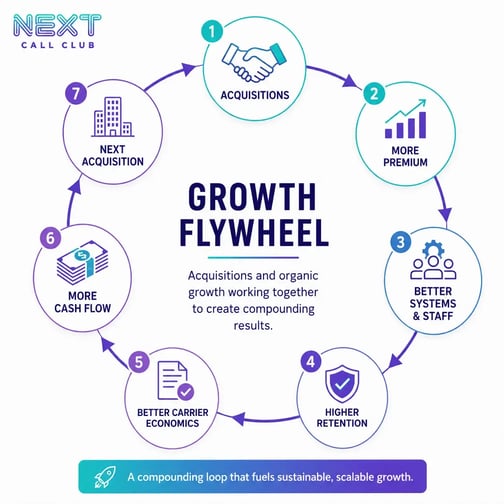
Acquisitions and organic growth are a compounding loop, and when you start thinking about growth that way, the whole strategy changes.
Acquisitions give you more premium, which funds better leads, better staff, and better systems. Better systems improve retention of the acquired book. Higher retention makes your agency more attractive for the next acquisition. The cycle continues.
If you want to hear this framework in full detail, I recorded a call on this with Vlad Cherchenko from Insurance Sales Lab. The video covers the acquisition side in depth, including the real deal numbers from each of our five purchases.
Building Engine 1: Organic Growth
Organic growth is the foundation of a healthy agency. If your growth depends entirely on acquisitions, one bad deal or a tough market can create pressure that leads to stress and anxiety. Organic growth gives you stability. It keeps you producing even when acquisition opportunities slow down or your team is stretched thin.
The agencies that grow past $10M in premium organically usually have one thing in common: they treat growth like an operational system, not just a marketing activity. That includes how they generate opportunities, how quickly they respond to prospects, how consistently they follow up, and how well they retain customers once they are on the books.
For most P&C agencies, direct mail and internet leads are still two of the largest scalable acquisition channels. The tactics behind them are different, but the agencies that perform well with either channel tend to operate the same way: disciplined processes, strong follow-up, clear visibility into the numbers, and consistent execution over long periods of time.
Direct Mail as a Scalable Growth Channel
Direct mail has been one of the core growth channels in insurance for decades, and for many agencies, it still drives a meaningful percentage of new business today. If you have ever received a letter offering an insurance quote comparison, mentioning rising rates, or encouraging you to review your current coverage, you have seen direct mail in action.
The reason it continues to work is pretty simple: it consistently puts agencies in front of households that are likely to shop for insurance. And unlike referrals, it scales in a much more predictable way when the economics are managed correctly.
A lot of larger agencies have built serious growth through direct mail over the years. Some producers still write a substantial amount of business every month from inbound calls generated by mail campaigns alone.
At the same time, the mail piece itself is only one part of the equation. A lot of the performance comes down to the operational process behind it.
List quality matters. The offer matters. Timing matters. And once a prospect calls or submits information, speed to contact, follow-up discipline, and producer consistency become just as important.
We have seen agencies spend heavily on mail campaigns and struggle because calls were not answered quickly, follow-up was inconsistent, or producers failed to work opportunities with discipline. We have also seen agencies with average creative produce strong returns simply because the operational process behind the campaign was solid.
Like most acquisition channels, direct mail tends to improve over time when agencies stay consistent with it. Better scripts improve close rates. Better retention improves lifetime value. Better targeting improves efficiency. Over time, the economy becomes much more predictable.
The biggest challenge today is cost. Direct mail is more expensive than it used to be, and optimization cycles move more slowly than digital channels. That is part of why many growing agencies now combine direct mail with internet leads and digital acquisition systems instead of relying entirely on one source.
Turning Internet Leads Into a Real Growth Engine
For most P&C agencies, internet leads are still the most scalable path to predictable organic growth. These are people actively shopping for coverage right now, and when the process is managed correctly, the economics can work extremely well.
Where most agencies struggle is not the leads themselves. It is the execution after the lead comes in.
If a prospect waits too long for contact, chances are they are already talking to another agent. The difference between a lead source that “doesn’t work” and one that produces strong ROI often comes down to speed, consistency, and follow-up discipline.
A few things matter more than almost anything else:
- Speed to lead is one of the biggest drivers of conversion. The first agent to connect with a prospect has a massive advantage. Agencies that scale successfully build their process around speed, not convenience.
- Consistent follow-up drives conversions. One call is not a follow-up strategy. Strong agencies stay consistent across calls, texts, and emails over multiple days, sometimes weeks, until the opportunity is fully worked.
- You need visibility into the numbers. If you don't know your contact rate, quote rate, and close rate by lead source, you're guessing at what's working. Every lead dollar should have a return you can measure and improve.
If you do not know your contact rate, quote rate, close rate, and cost per sale by lead source, it becomes almost impossible to improve performance consistently. The agencies that scale well know exactly where the bottlenecks are and adjust quickly.
This is a big part of what we focus on at Next Call Club. Most agents already understand these concepts in theory. The real challenge is building a process that the team actually follows every single day.
How to Get More Growth From the Book You Already Have
Retention is one of the highest leverage growth strategies an agency has, but most agents only think about it as a defensive metric. In reality, improving retention creates new revenue without increasing lead spend, hiring more producers, or adding more operational complexity.
A small retention improvement changes the economics of an agency fast. For example, a $5M book running at 85% retention that improves to 89% retention keeps an additional $200,000 in premium on the books without writing a single new policy. Over multiple years, the gap between an agency retaining 84% and one retaining 90% becomes massive. It also has a direct impact on agency valuation if you ever decide to sell.
At the operational level, retention is usually much simpler than people make it. It comes down to proactive service. Reaching out before clients have a reason to call you. Making sure they understand what they have, why they have it, and where they may be exposed. The agencies that do this consistently tend to keep clients longer and grow faster over time. That's it.
How to Use Rate Increases as a Growth Catalyst
Rate increases are often treated as pure damage control. Used correctly, they can become a growth catalyst and an opportunity to strengthen relationships and improve retention.
I’ll be direct: rate increases have helped us a lot. Most agents immediately see them as a retention risk, and to some extent, they are. But the agencies that perform best during rate increase cycles are usually the ones that communicate proactively instead of reacting after the renewal hits.
When clients open a renewal and see a higher premium without context, frustration kicks in immediately. When you call beforehand and explain what is happening in the market, what changed, and what options they have, the conversation feels completely different.
Some clients were always going to shop. Some were always going to stay. The clients in the middle are the ones you keep through real conversations and proactive advising.
There is also a straightforward math tailwind here. If your book is $10M and rates increase 8% across carriers, renewal revenue increases by roughly $800,000 without writing a single new policy. That compounds year over year.
Building Engine 2: Strategic Acquisitions

Acquisitions let you compress years of growth into much shorter timeframes. They can create immediate increases in premium, unlock compensation structures you cannot access at your current size, open new geographies, and add operational scale much faster than organic growth alone.
At the same time, acquisitions tend to amplify whatever operation already exists underneath them. If an agency already has strong lead management, disciplined follow-up, proactive service, and healthy retention systems, a newly acquired book can improve surprisingly fast after the transition. If those systems are weak, acquisitions usually create more operational problems instead of more growth.
That is why the real value of an acquisition usually goes beyond the premium itself. A lot of the value comes from what your operation is capable of doing with the book after the deal closes. Some acquisitions are about immediate cash flow. Others are more strategic and tied to long-term growth plans, carrier relationships, or expansion opportunities. The right deal depends entirely on what you are trying to accomplish as an agency owner.
A lot of buyers also underestimate how much deal structure changes the economics. Financing terms, seller involvement, retention agreements, and transition planning can completely change how a deal performs financially over time.
And in many cases, the best opportunities never formally hit the market. Carrier relationships, bankers, industry networking, and direct outreach consistently produce better opportunities than waiting for public listings.
How Both Engines Work Together: The Growth Loop
Here's what this looks like in practice.
You build a strong organic operation first: internet leads supported by disciplined contact and follow-up systems, proactive service, and strong retention. That creates steady premium growth and consistent cash flow.
That cash flow then funds acquisitions, either directly or through bank financing backed by the strength of the existing business. Once you acquire a book, you apply the same retention and client contact systems to those new customers.
Most acquired books have been underserved for years. The previous owner may have been winding down, running lean, or simply not communicating consistently with clients anymore. Better processes alone can dramatically improve retention and customer experience after the acquisition.
As retention improves, carrier performance improves with it. Better carrier metrics can unlock stronger compensation structures on the new business you are already writing organically. That additional revenue helps fund the next acquisition.
The cycle compounds over time. That's the $40M path.
The Mistake That Breaks the Loop
The most common mistake I see is agents acquiring a book and immediately slowing down on new business production.
They buy a $3M book, look at the debt service, and decide to coast on renewals for a while. It feels reasonable in the short term, but it damages the agency in the long term.
Carriers expect acquired books to continue growing, not simply maintain existing premiums. When production slows after an acquisition, carrier relationships weaken, and the momentum that made the acquisition valuable in the first place starts to disappear.
Acquisitions accelerate growth. Organic growth sustains it. Both engines have to run at the same time.
How to Get Started
If you're already operating an agency and thinking about growing past your current size, here's where to begin.
Get the organic engine running first.
Before layering acquisitions on top, make sure you already have a disciplined and measurable lead management process in place. The same systems that improve retention on acquired books need to work consistently inside your core operation first.
Get clear on why you want to acquire.
Cash flow, compensation access, geographic expansion, and carrier strategy all lead to different acquisition decisions. Your reason for buying changes what you should buy, how much you should pay, and how the deal should be structured.
Start building relationships now.
The best deals come through carrier relationships, networking, industry conversations, and being known as a credible buyer.
Use a due diligence checklist.
Acquisitions involve financing, carrier approvals, compliance, operational transitions, retention planning, and deal structure. A good checklist prevents expensive mistakes and keeps deals organized from start to finish.
Go Deeper on the Acquisition Side
This article covers the framework at a high level. For a deeper breakdown on valuation, financing, deal structure, due diligence, and common mistakes, read the full acquisition guide:
How to Buy a P&C Insurance Agency: A Complete Guide
And if you are actively evaluating an acquisition and want a practical framework to review the opportunity, download the Free Agency Buying Checklist.
Leave a Reply