


Your carrier gave you a web page. It has your name, your headshot, maybe a scheduling link. It looks clean enough. So why would you spend money building your own site?
Because that carrier page might be working against you.
We sat down with insurance agency operators, marketers, and producers to get real answers on the website question, not theory, but what's actually happening with leads, conversions, and brand equity. Here's what we found.
The Carrier Page Problem Nobody Talks About
Here's the sharp reality: a lot of carrier-provided websites redirect prospects to the corporate call center or an online quote-and-bind flow, and the agent doesn't get credit for it.
Think of it this way. The carrier is using your name, image, and likeness for their own purpose and gain. All that community work you're doing, all those sponsorships, all that direct mail, it's feeding the call center, not your book.
Beyond the lead leakage, there are practical limitations that stack up fast:
- No customization. Want to update your bio or swap out your headshot? It goes through company approval, and it's rarely instant.
- No integrations. Most carrier scheduling tools don't sync with your actual calendar. Missed appointments, missed quotes.
- No analytics or pixels. You can't install Facebook, TikTok, or Google retargeting pixels on a carrier page. Those leads just float away.
- No SEO upside. You can't meaningfully improve search rankings for a page you don't control. Running ads to it isn't practical either.
- No differentiation. Your page looks identical to every other agent at the same carrier. Customers have no reason to pick you over the next name in the search results.
You're spending your own dollars to drive marketing and leads to your business. Why build equity for the carrier's brand instead of your own?
Why a Custom Website Actually Moves the Needle
Having your own website isn't just about looking professional, although that matters more than most agents think. It's about control, conversion, and compounding value.
It Legitimizes You to Cold Prospects
When someone gets your mailer, sees your caller ID, or hears your name as a sponsor, the first thing they do is Google you. What do they find?
If you have a clean, professional website, you look established. If all they find is a generic carrier landing page, or worse, nothing, you look like everyone else.
Your website is your backstop of trust for every piece of outbound marketing you run. Direct mail, telemarketing, billboards, all of it performs better when the prospect can look you up and feel confident.
It Doubles Your Google Real Estate
Think of Google like real estate. Your carrier page is your home. Your website is an investment property. Now when someone searches your name, you take up more space on their screen. More coverage, more credibility, more clicks.
It Creates a Lead Funnel You Actually Own
With a carrier page, there's nowhere for a prospect to go if it's after hours or they don't want to call. With your own site, you can build a quote request form, capture contact info, and follow up on your terms.
This is especially powerful for referrals. It's not uncommon for a referral, a returning client, or a current customer wanting to add a line of business to come through a website form instead of calling.
The Leads Convert at a Completely Different Level
This is where it gets real. Here's what we're seeing across our operations:
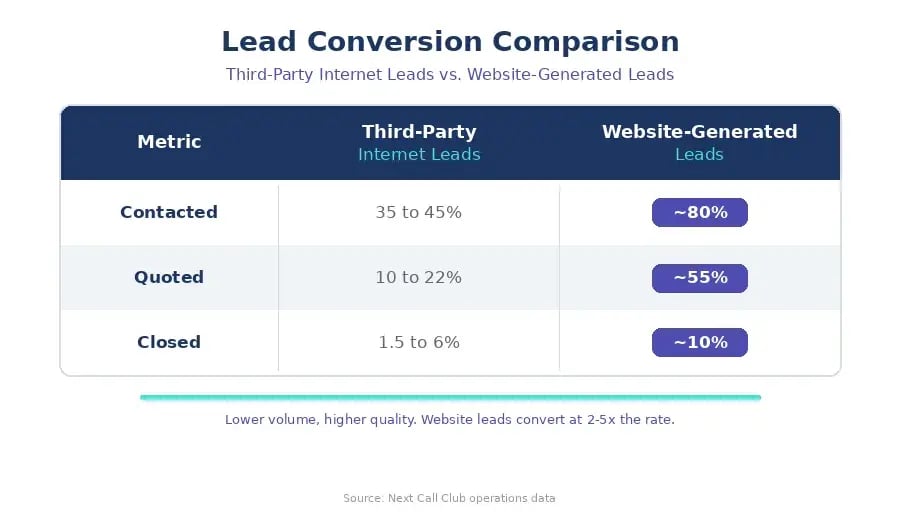
The volume is lower, website leads typically spike around marketing pushes like mail or community outreach, but the quality is in a different league. These people requested a quote directly from you. They're exclusive, they're warm, and they already know your brand.
It Protects Your Business Long-Term
If you ever leave your carrier, or the carrier leaves you, what happens to your online presence? With a carrier page, it's gone. With your own brand and website, you retain the traffic, the reputation, the SEO rankings, and the brand equity.
That equity adds real enterprise value if you ever want to sell your agency. Think about the trusted local brands in your market, how much is that instant recognition worth?
"But I'm Just Starting Out, Do I Really Need One?"
Yes. The advice is the same whether you're brand new or doing $100M+ in premium.
If you're in a big city, you have a ton of competition. An amazing online presence, reviews and website, is how you stand out. If you're in a small town, consider this: if every small-town agent assumes they don't need a website, and you're the one who has one, who gets the business when someone Googles "insurance near me"?
The only real barrier for a newer agent is cost. But here's the thing:
- A one-page Squarespace site costs very little to maintain.
- You can follow a template and build it yourself.
- Even a basic site gives you a lift over having nothing.
For bigger agents, the upside is clear. Your website becomes the cornerstone of all your marketing. All roads lead back to it.
The SEO Opportunity Most Agents Are Missing
Local SEO is where a custom website really separates itself from a carrier page. Your carrier page will never show up in general "insurance near me" searches. That's just reality.
But a custom website with location-based pages, think "auto insurance in Peachtree Corners" or "home insurance in East Cobb," can rank in the top five for those terms. We're doing it right now.
Local SEO hits hardest when the person you're already marketing to is in the area. They Google you and see a wealth of information. Then they Google local insurance in general, and there you are again. That one-two punch is powerful.
And here's what makes SEO special: it compounds over time. It's one of the cheapest, most sustainable forms of marketing. The leads are essentially free once you're ranking. All it takes is some content, consistency, and a little patience, six months or more in some cases.
With AI tools now, creating blog content has never been easier. If you have a marketing person on staff, SEO can easily become part of their routine without much additional lift.
Compliance: What to Watch Out For
Striking out on your own web presence comes with a few things to keep in mind:
Know your carrier's rules. Find out ahead of time how you can use the carrier's name, logo, and branding in your own marketing. Some carriers don't like you mixing brands. In that case, market entirely under your own agency name and use terms like "agent" on your site to make the relationship clear without confusing consumers.
Test your forms. If you're building contact or quote request pages, test them weekly. Make sure every submission triggers an alert. Broken forms are worse than no forms.
Keep content accurate. More content means more responsibility. Don't guarantee things you can't guarantee. Stay away from compliance-shaky territory in your blog posts. This should be second nature for any licensed agent, but it's worth remembering as you scale content production.
First-party consent is a strategic advantage. Third-party internet leads may face more regulatory scrutiny in the future, and verifying how you can market to them is getting harder. With first-party leads from your own site, you control the consent language. Build in permission for text messages and email, then market from multiple angles, not just telemarketing.
What It Actually Costs
We've invested roughly $25,000 to $30,000 over seven years, which breaks down to just a few thousand dollars per year.
But you don't need to start there. Here's the range:
- Basic one- or two-page site: Under $1,000
- Professional, well-designed site with backend optimization: Up to $10,000
- Ongoing content and SEO: Varies, but AI tools have drastically reduced the cost of blog production
Was it worth it? Absolutely. Not just for prospects, but for recruiting. A career page with photos, awards, and culture highlights makes a real difference in the interview process. Potential employees look you up, too.
You can use tools like Bolt or Lovable to build a site yourself, but be honest about your technical ability. Plenty of people get the front-end designed and never deploy the code, or their site breaks and they can't fix it. If you go the DIY route, make sure you understand the basics of hosting and maintenance.
If You Do Nothing Else, Do These Three Things
If you're not ready for a full website buildout, start here:
- Install your pixels immediately. Facebook, TikTok, Google Analytics, and retargeting, even on a basic site, this lets you build audiences for future campaigns.
- Start warming your email domain. Register your domain and begin sending from it right away. This ensures a smooth transition to email marketing when you're ready.
- Ask for Google reviews early and often. Your reviews are the foundation of your online presence. Get your team in the habit. A high rating with volume gives you proof of concept before a prospect ever visits your site.
The Bottom Line
A carrier page is not a website. It's a landing page you don't control, can't customize, and that may be actively siphoning leads away from you.
Your own website, even a simple one, legitimizes your business, improves your marketing ROI, generates higher-quality leads, and builds equity that's yours forever.
The best time to build it was when you started your agency. The next best time is today.
Next Call Club helps insurance agents and agencies generate leads, book appointments, and grow their book of business.
Leave a Reply