
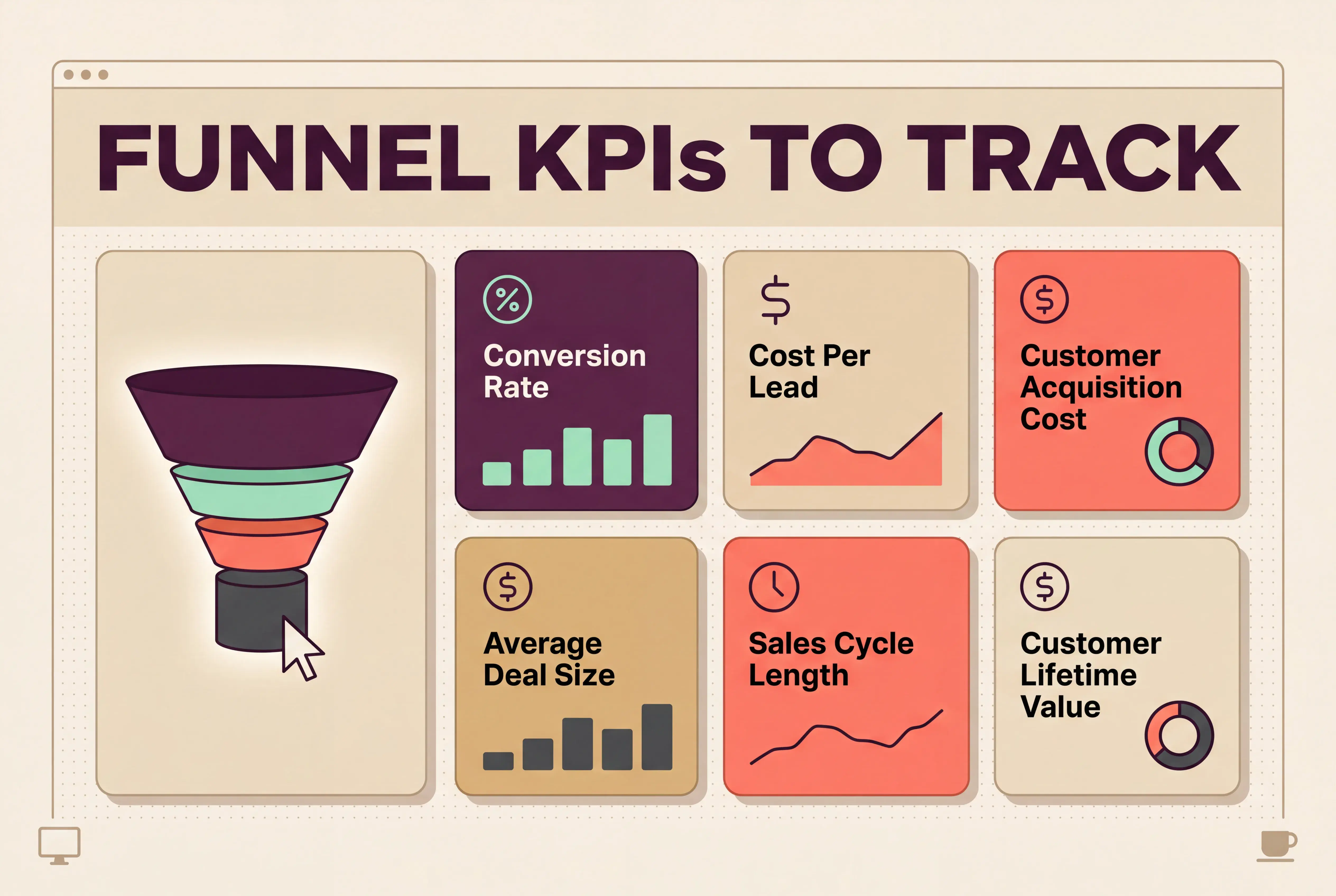

CPL isn't a fixed price. It's a variable that reflects your traffic mix, your bidding position, and your filter choices. Here's what's actually moving it and why optimizing for it is the wrong goal.
Agency owners ask about cost per lead constantly. It's a natural question. You're spending money on leads every month, and you want to know what the number is supposed to be.
The problem is that cost per lead doesn't have a fixed answer, and the agencies that treat it like one end up optimizing for the wrong thing. CPL varies because it's tracking real differences in traffic quality, bidding competition, and the choices you're making about what you're willing to accept. When it changes month to month, that change is telling you something. Most agencies aren't reading what it says.
Here's what's actually driving the variability, why chasing a lower CPL is often counterproductive, and what number you should be tracking instead.
CPL is a variable, not a price tag

Most agencies think of cost per lead as something a vendor sets. The vendor has a price, you pay it, done. That's not how it works.
Lead pricing is dynamic. It shifts based on what other agencies in your market are bidding, what traffic sources are in the mix, what filters you've put on your account, and what time of year it is. A lead that costs $12 in January might cost $18 in March if competition in your ZIP codes picks up. A lead that costs $15 from one source might cost $8 from another, but those two leads won't convert at the same rate.
You're spending money on internet leads every month, and you want to know what the number is supposed to be, but CPL doesn't have a fixed answer.
When your CPL changes, it usually means one of three things: the competition in your market shifted, your traffic mix changed, or your filter settings narrowed or widened the pool you're buying from. None of those changes are random. All of them are worth understanding.
The source determines the price and what you get with it

Not all leads are generated the same way, and the way a lead was generated has a direct relationship to how that person behaves when you call them.
A lead generated from search advertising- someone who typed a query, clicked an ad, and filled out a form- is expressing active intent. They're looking for insurance right now. That kind of traffic costs more because it converts better: more pickups, more quotes, more binds. A lead generated from a display ad or a broad social campaign costs less because the person wasn't necessarily in the market when they saw it. Their intent is lower, and you'll feel that on the phones.
This is the insight behind a counterintuitive reality in lead buying: a $10 CPL is sometimes worse than a $40 CPL, and a $40 CPL can be a bargain. If you buy 100 leads at $1 each and none of them answer the phone, you've spent $100 and produced nothing. What your cost per lead should be walks through how to calculate the right CPL for your agency based on your close rate and commission. If those same 100 leads cost $15 each but 40 of them pick up and a quarter of those bind, you've spent $1,500 and written real business. The CPL is five times higher. The cost per sale is dramatically lower.
The metric that actually matters is cost per sale, not cost per lead. CPL is an input. Cost per sale is the output. Agencies that optimize for the lowest CPL without thinking about what they're trading away in quality often discover this the hard way.
What happens when you bid below the market

Within a single traffic source or vendor, the leads aren't all equivalent. Higher bids generally capture better inventory. Lower bids capture what's left.
Here's why: lead vendors and aggregators are running auctions, whether formal or informal. When you place a bid below what competitors are offering for a given ZIP code, demographic, or lead type, the better opportunities go to the higher bidder first. Better insurance lead funnel filtering covers how to structure your filtering logic so you're not accidentally pricing yourself into the leftovers. You receive the inventory that didn't get claimed at a higher price.
This is one of the most common hidden costs of chasing a lower CPL. An agency lowers their bid to cut costs, their CPL drops, and for a few weeks the economics look better on paper. Then contact rates start to slide, close rates follow, and by the time the cost-per-sale number catches up, a lot of damage has been done.
The risk is especially pronounced in competitive markets. If another agency is aggressively bidding across the ZIP codes or sub-verticals that perform well in your area, your lower bid gets you everything they passed on. That's a very different product than what you thought you were buying.
How your own filter choices move the number

The decisions you make about what leads to accept have a direct effect on your CPL, sometimes in ways that aren't obvious.
Narrow your geographic footprint to only the highest-performing ZIP codes, and you shrink the pool of leads available to you. A smaller pool means you're competing for less inventory, but it also means your SDR team or your lead vendor has fewer options to fill your daily order. Depending on how tight the restrictions are, this can push the effective price per lead up because you're cherry-picking from a smaller supply.
The same logic applies to age ranges, policy types, and other filter settings. The more specific the criteria, the more selective you're being, and the more you're likely to pay per lead that meets it. That can be the right trade. But agencies that keep adding restrictions without tracking the downstream effect on cost per sale are often surprised when the economics don't improve the way they expected.
NCC's account managers review filter settings in monthly account optimization reviews and look specifically at whether restrictions are supported by performance data. Tightening filters before there's a meaningful sample size is one of the most common ways agencies hurt their own results without realizing it. The right time to restrict is after you know what the data says, not before.
The number you should actually be tracking
Cost per lead tells you what you're paying to fill the top of your funnel. Cost per sale tells you whether the funnel is working.
To calculate it, you need four numbers:
- How many leads did you buy?
- How many of those did you close?
- What did the leads cost in total?
- What does your commission look like on the average new policy?
Divide your total lead spend by the number of policies written, and you have your cost per sale. That number tells you whether the channel is profitable at your current volume and close rate. A CPL of $20 with a 12 percent close rate and a $400 average commission looks completely different from a CPL of $35 with an 18 percent close rate and the same commission. What close rate actually means breaks down how to calculate it and why the number shifts depending on how you define a worked lead.
The agencies that get the most out of NCC's lead program are the ones who show up to their monthly review with real cost-per-sale numbers, not just a gut feeling about whether leads felt expensive this month. That data is what tells us whether to adjust your bid, shift your traffic mix, or look at what's happening on the agent side.
What NCC's tiered campaign structure does to your CPL

One of the reasons CPL varies in practice is that NCC structures lead campaigns in tiers, with each tier priced differently based on the performance of the underlying traffic sources. Why NCC runs three campaigns per vertical at different prices explains the waterfall structure in full, including how the tiers interact with your overall CPL.
Tier 1 traffic pulls from the highest-performing sources. It's priced at the top of the range because it converts at higher rates. Tier 2 and Tier 3 pull in progressively broader sets of sources at lower price points. The blended CPL across all three tiers lands somewhere in the middle, and that middle shifts depending on how much volume you're pulling from each tier in a given month.
This is why your CPL from NCC doesn't look the same every month. It's not inconsistency. It's the natural result of a campaign structure designed to give you the right mix of volume and quality rather than locking you into a single flat price that either leaves money on the table or overcharges you for traffic that doesn't justify it.
Understanding this is key to reading your monthly account data accurately. A CPL that ticked up slightly might mean more Tier 1 traffic came through, which should show up as a better contact rate and close rate on the back end. A CPL that dropped might mean the month was heavier on Tier 3, which is worth watching at the cost-per-sale level.
How to have a more productive conversation with your lead vendor about CPL

If your CPL is higher than you expected, or if it changed and you don't know why, these are the questions worth asking:
- What's in my current traffic mix? How much am I pulling from each source tier?
What goes into an NCC lead quality check explains how NCC evaluates and assigns each traffic source before it reaches your campaigns.
- Has competition in my ZIP codes or demographics increased recently?
- Did any filter changes go into effect in the last 30 days?
- What is my current cost per sale, and how does it compare to last quarter?
- Is my contact rate consistent with what it was when CPL was lower?
Why your contact rate is low covers the full list of causes worth checking when your contact numbers start to slide.
The answers to those questions will tell you more about your lead program's health than the CPL number itself. CPL without context is just a cost. CPL in the context of contact rate, close rate, and cost per sale is a diagnostic.
If you're not getting clear answers to those questions from your current lead vendor, that's worth noting too. A vendor who can't explain why your CPL moved isn't one who can help you optimize it.
The bottom line

Your cost per lead is variable because the inputs that create it are variable. Traffic source, bidding competition, filter settings, time of year, and market dynamics all push the number up or down. That variability is normal. What isn't normal is accepting variability without understanding what's driving it.
The agencies that run successful lead programs have a clear picture of their cost per sale, not just their CPL. They know what their close rate is, what their average premium looks like, and what a profitable cost per acquisition means for their specific commission structure. When CPL moves, they look at those downstream numbers before concluding.
If you want to work through what a cost-per-sale target should look like for your agency, or if your current CPL is producing results you're not happy with, reach out to the NCC team. We'll look at the full picture with you.
Leave a Reply